

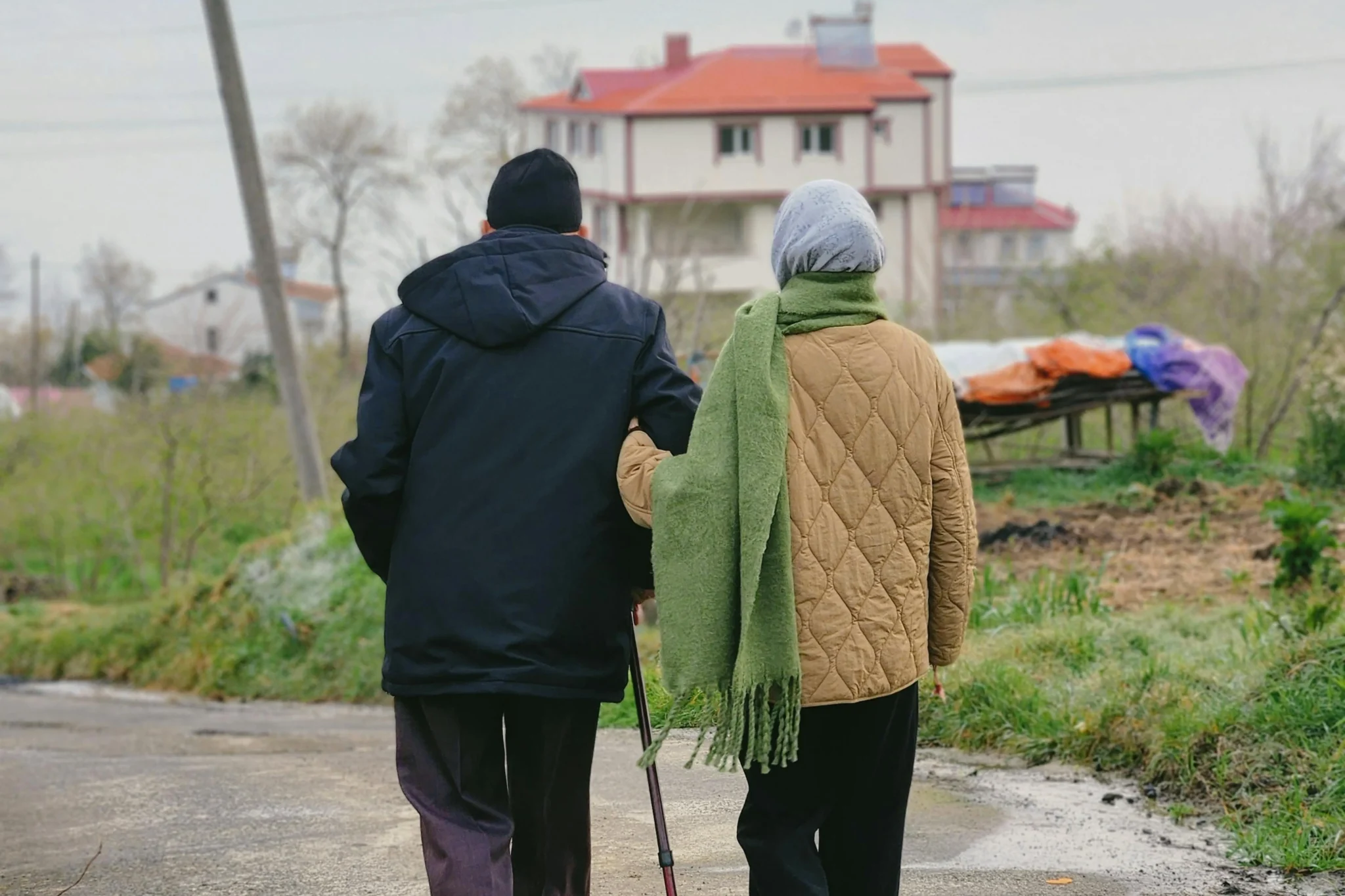
What makes loneliness different in villages, what do the data on rural aging say, and what works when there are few people and few resources.
In villages, the loneliness of the elderly is compounded by distance: services far away, limited transport, an aging population, and families living in the city. What works best is to take advantage of existing proximity, share resources between municipalities, and sustain small but stable activities.
Bringing solutions designed for the city doesn't usually work. Below you'll find the data, the characteristics of rural loneliness, six measures that work on a small scale, and the role that remote contact can play.
In rural municipalities, more than one in four people is 65 or older. Distance and transportation are as significant challenges as the lack of social interaction. Small towns have one advantage: everyone knows each other. Intermunicipal associations and provincial councils can support communities that a single town cannot.
A very aged rural environment
How much older are the villages? Quite a lot. In municipalities with 2.000 inhabitants or less, 28,5% of the population is 65 years old or older, compared to 19,5% in urban municipalities, according to the CSIC report. A profile of older people in Spain, 2024, with data from 2023.
Pay attention to this: aging does not automatically mean loneliness. In many communities, community life remains vibrant. But when a person loses mobility, becomes widowed, or stops driving, the risk of becoming isolated is much greater than in a city.
Characteristics of rural solitude
| Factor | How it influences |
|---|---|
| Distance to services | The health center, day center, or pharmacy may be in another town |
| Transport | Without your own car, leaving the village depends on limited schedules or on a neighbor. |
| Family far away | Children and grandchildren live in the city, and visits are concentrated during holidays. |
| Scattered dwellings | In some areas, the nearest house is miles away. |
| Winter | The cold weather and short days greatly reduce outings and life on the street |
| Pride and discretion | In small communities it is harder to recognize that help is needed |
In the face of all that, the people have a huge advantage: the proximityThe shopkeeper, the postman, the baker who makes deliveries, or the mayor all know everyone and notice immediately when someone stops showing up.
Six measures that work on a small scale
- Set up a warning network with those who are already there. So that the store, pharmacy, or home delivery service knows who to notify if someone stops showing up.
- Schedule a meeting every week. The same day, the same time, the same place: the community center, the bar, the library. Better small and consistent than large and sporadic.
- Organizes shared transportation. A vehicle on demand or a schedule of trips to the main town for doctor, shopping and activities.
- It shares resources with other municipalities. Associations of municipalities and provincial councils can support itinerant workshops, physiotherapy or sociocultural activities.
- Add to the school. When available, it is a natural ally for intergenerational activities.
- Call the person who can't go out. A regular call each week, from social services or from volunteers, keeps the thread going between visits.
A warning about coordination. None of these measures are expensive, but they all need something that's sometimes lacking: a person or service to coordinate them and ensure they don't fall through. We'll review more ideas in What can local councils do to combat unwanted loneliness?.
The role of long-distance contact
Short answer. In rural areas, technology makes more sense than anywhere else, because it shortens real distances: video calls with family, telecare, or guided activities when it is not possible to travel.
However, there are some challenges: unreliable internet connections, poorly adapted devices, and people with no digital experience. That's why it works best when someone guides you through the initial use and when combined with in-person meetings.
En Inrobics We also work with remote solutions, such as our telerehabilitation from homeAnd one of the things we've learned most is that technology only works when there are people behind it to support it.
Checklist for a small municipality
FAQ
Loneliness appears in both environments, but with different characteristics. In villages, the distance to services, transportation, and distant family weigh more heavily; in cities, it's anonymity.
According to the CSIC, in municipalities with 2.000 inhabitants or less, 28,5% of the population is 65 years old or older, compared to 19,5% in urban areas.
Create a notification network with businesses and residents, organize a regular weekly meeting and make regular calls, and rely on the association or the provincial council for what requires more resources.
You can shorten distances with video calls, tele-assistance or remote activities, provided there is a good connection and someone to accompany you during the first uses.
After losing a partner, giving up driving or losing mobility, and in winter, when the cold and short days reduce outings.
Fonts
- Pérez Díaz J, Castillo Belmonte AB, Aceituno Nieto P, Ramiro Fariñas D. A profile of older people in Spain, 2024. Basic statistical indicatorsCSIC, December 2024.
None of the links in this article are sponsored. Inrobics We develop social robots and telerehabilitation tools; when we talk about our technology, we make that clear.
Reaching those who live far away, without losing the closeness
If you're looking for new ways to keep older people in your area active, we'll tell you how we combine social robotics and remote activity.
Let's talk for 15 minutesWithout obligation
Read
"In a small town, what's lacking isn't closeness, but someone to coordinate it."
