

Reading time: 8 minutes
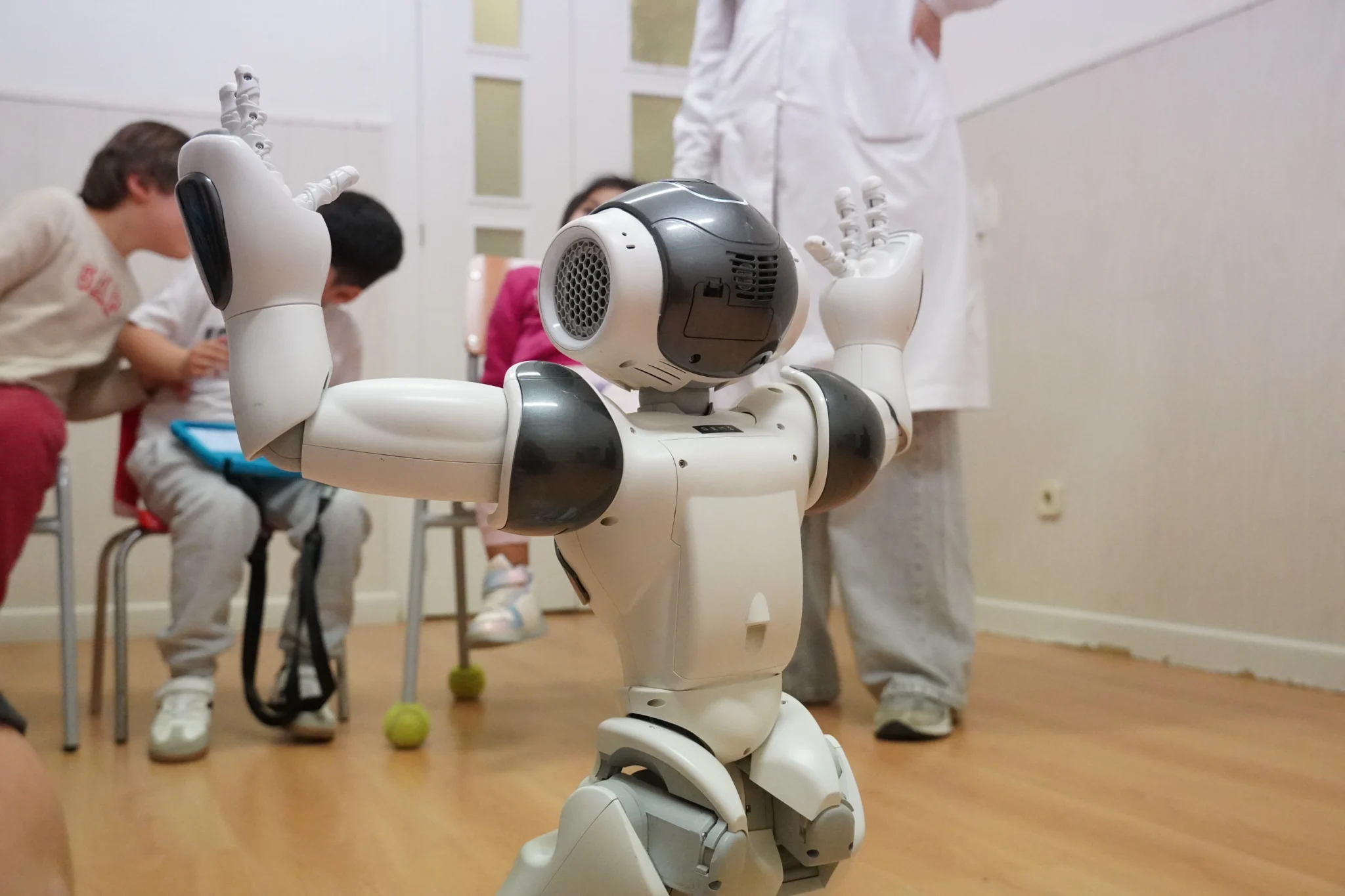
Fast answer: A social robot can be integrated into the special education classroom without changing the programming if it is used as a resource for existing objectives: communication, turn-taking, attention, imitation of movements, or autonomy. It works best at a fixed time of the week, with small groups, with visual cues, and with the teacher guiding the activity.
In 30 seconds
- The robot does not bring new programming: it is put at the service of the programming that the classroom already has.
- The important thing is to choose two or three specific goals and a fixed time to work on them.
- Anticipation and routine are as important as the robot itself.
- The teacher, the specialist in hearing and language or in therapeutic pedagogy continues to lead the session.
In this article
- The context: a very diverse student body
- Why there's no need to change the programming
- Step-by-step integration
- From classroom objectives to the activity with the robot
- How to involve families
- Frequent errors
- FAQ
The context: a very diverse student body
In a special education classroom, students with very different profiles coexist: cerebral palsy, autism spectrum disorder, intellectual disability, multiple disabilities. Each one has individual goals, and the teaching team juggles to attend to them all with the time and resources they have.
Key data
In the 2024-2025 academic year, there were 319.115 students in Spain with special educational needs associated with disabilities or serious disorders. 85,7% were enrolled in mainstream education, and 14,3%, or 45.770 students, were in specific special education programs, according to the Ministry of Education, Vocational Training and Sport.
Given this situation, any new resource raises a reasonable question: will it be an added burden? The experience of centers working with social robotics suggests not, provided it is integrated thoughtfully.
Why there's no need to change the programming
A social robot is not a subject or a new method. It is a resource, like pictograms, digital whiteboards, or sensory materials. Its value lies in the fact that many students pay special attention to it: it moves, speaks, responds, and repeats without getting tired.
Therefore, the correct question isn't "what do we do with the robot," but rather "what programming objective can we best address with it?" If a student's objective is to take turns, imitate movements, or ask for help, the robot can be the perfect pretext for practicing these skills in a more engaging way.
If you're interested in knowing where these robots come from and what they can do, we'll tell you in the evolution of social assistance robots.
Step-by-step integration
1. Choose two or three objectives that already exist
Review classroom schedules and individual plans and choose objectives where attention or motivation are the bottlenecks. For example: joint attention, functional communication, motor imitation, or patience.
2. Set a time of the week
Two fixed sessions of 20 or 30 minutes are better than many scattered sessions. Routine provides security, especially for students who need predictability.
3. Anticipate with visual aids
Include the robot in the classroom's visual schedule, using its pictogram. Before the first session, introduce it in a photo or short video. For many students, knowing what's going to happen is the difference between participating and freezing up. If you're not yet using visual aids, you can find a guide at [link/website/etc.]. pictograms and visual schedule in the classroom.
4. Start with small groups
Two or three students per session at first. This allows the teacher to observe how each one responds and adjust the activity accordingly.
5. The teacher leads, the robot accompanies
The robot suggests, encourages, and repeats. The teacher or specialist decides when to move forward, when to stop, and how to adapt the activity to each student.
6. Register only what is necessary
A simple sheet with the date, who participated, and one observation per student about the objective covered. In a few weeks, that record speaks louder than any printed copy.
From classroom objectives to the activity with the robot
This table shows how common goals are connected to simple activities, without altering the schedule:
| Classroom objective | Activity with the robot | What to observe |
|---|---|---|
| Respect turns | The robot calls each student by name to participate | If he waits his turn and if he responds when he hears his name |
| Motor imitation | The robot makes a movement and the student repeats it. | What movements does it imitate and with how much help? |
| Functional communication | The student asks the robot to repeat or change games, using voice, sign, or pictogram. | Spontaneous communicative initiatives |
| Sustained attention | A short story narrated by a robot with questions at the end. | Time that holds attention |
| Autonomy | The robot guides the steps of a routine: washing hands, preparing the backpack | Steps he/she takes without adult help |
Note that the third column refers to observing, not measuring clinical outcomes. The goal of this resource is to encourage students to participate more and practice more, within their existing plan.
In the case of students with cerebral palsy, the motor and educational aspects are often closely linked. We explain this in our article on Cerebral palsy in children and its rehabilitation.
How to involve families
Families often receive the news that there will be a robot in the classroom with a mixture of curiosity and doubt. Explaining it clearly from the beginning avoids misunderstandings and also establishes a line of communication between school and home. There are specific tools for this purpose at coordination between school and family in special education.
- Explain what it's used for. with the specific objectives of each student, not with generalities about technology.
- Make it clear that it doesn't replace anyone: The teaching staff and specialists remain the same.
- Sharing what is observed, For example, in the agenda or in the quarterly meeting: "this week he requested an appointment on his own."
- Invite someone to watch a session, If the school's organization allows it. Seeing the student participate usually resolves more doubts than any explanation.
- Ask for their opinion: Families know each other's tastes, fears, and songs that can make an activity engaging.
And a practical matter that should be resolved before starting: if photos or videos are going to be taken of the sessions, even for internal use, the corresponding authorizations from the center and the families must be obtained.
Frequent errors
- Use it as a reward. If the robot only appears when the student behaves well, it ceases to be a learning resource.
- Sessions that are too long. The novelty effect wears off quickly; short, regular sessions are best.
- Large groups from the beginning. The teacher loses the ability to adapt the activity.
- Do not anticipate. Introducing a new element without warning can generate resistance, especially among students with autism.
- Leave it in the hands of a single person. If only a professional knows how to use it, the resource disappears when she is not there.
En Inrobics We work with Robic, our therapy robotThis is also true in special education schools, and always with the same principle: the classroom team decides what to work on, and the robot adapts accordingly. It's yet another way for inclusion to reach everyone, as we mentioned in the World Children's Day.
Checklist before the first session
- Have we chosen two or three objectives from the current programming?
- Do we have a fixed weekly schedule?
- Is the robot on the classroom visual agenda?
- Do we know which students will start and in which groups?
- Are there at least two people on the team who know how to set it up?
- Do we have a simple registration sheet prepared?
- Have the families been informed?
FAQ
No. The robot is just another resource. The teacher or specialist decides which objectives to work on, leads the session, and adapts the activity to each student.
No. It is recommended to use it to work on objectives that are already in the programming and in individual plans, such as turns, imitation, communication or autonomy.
Initially, sessions should last between 20 and 30 minutes, with groups of two or three students. Short, regular sessions are preferable to long, sporadic ones.
Yes, paying special attention to anticipation: including the robot in the visual schedule, introducing it beforehand with a photo or video, and maintaining a stable routine.
No programming skills are required. A brief initial training is all that's needed to get it up and running and choose activities. It's advisable that at least two people on the team know how to use it.
to close
A social robot in the special education classroom isn't meant to change what the team is already doing well. It's meant to help some students participate more and practice what they're already working on. With clear objectives, a fixed schedule, and good planning, it can be integrated in just a few weeks.
Do you want to see how a social robot would fit into your classrooms? Let's talk for 15 minutes, without obligation.
Fonts
- Ministry of Education, Vocational Training and Sports. Students with specific educational support needs. Academic year 2024-2025. Summary note. April 2026.
