

Reading time: 8 minutes
Fast answer: A physical robot tends to attract more attention in group sessions because it's physically present in the room. An avatar on a screen is easier to move around, use in different spaces, and take home. In a day center, the choice depends on the size of the groups, the available space, and whether the sessions are repeated in several rooms.
In 30 seconds
- The research suggests that what makes the difference is the physical presence in the room, rather than the robot's appearance.
- A robot and an avatar on screen do not compete: they solve different needs.
- The robot is better suited to group sessions with a fixed space; the avatar, to centers with several rooms or with continuity at home.
- Neither of them replaces the professional: both help them reach more people.
In this article
- What are we talking about?
- What does research say about being present?
- Point-by-point comparison
- When is it appropriate for each one?
- How to plan the first few weeks
- Six questions to help you decide
- FAQ
What are we talking about?
When a day center considers using social robotics, the first question is usually very specific: do we buy a robot that sits on the table or do we use a screen with a virtual character? Both options promise the same thing on paper: guiding activities, encouraging participation, and providing continuity to sessions. In practice, however, they behave quite differently.
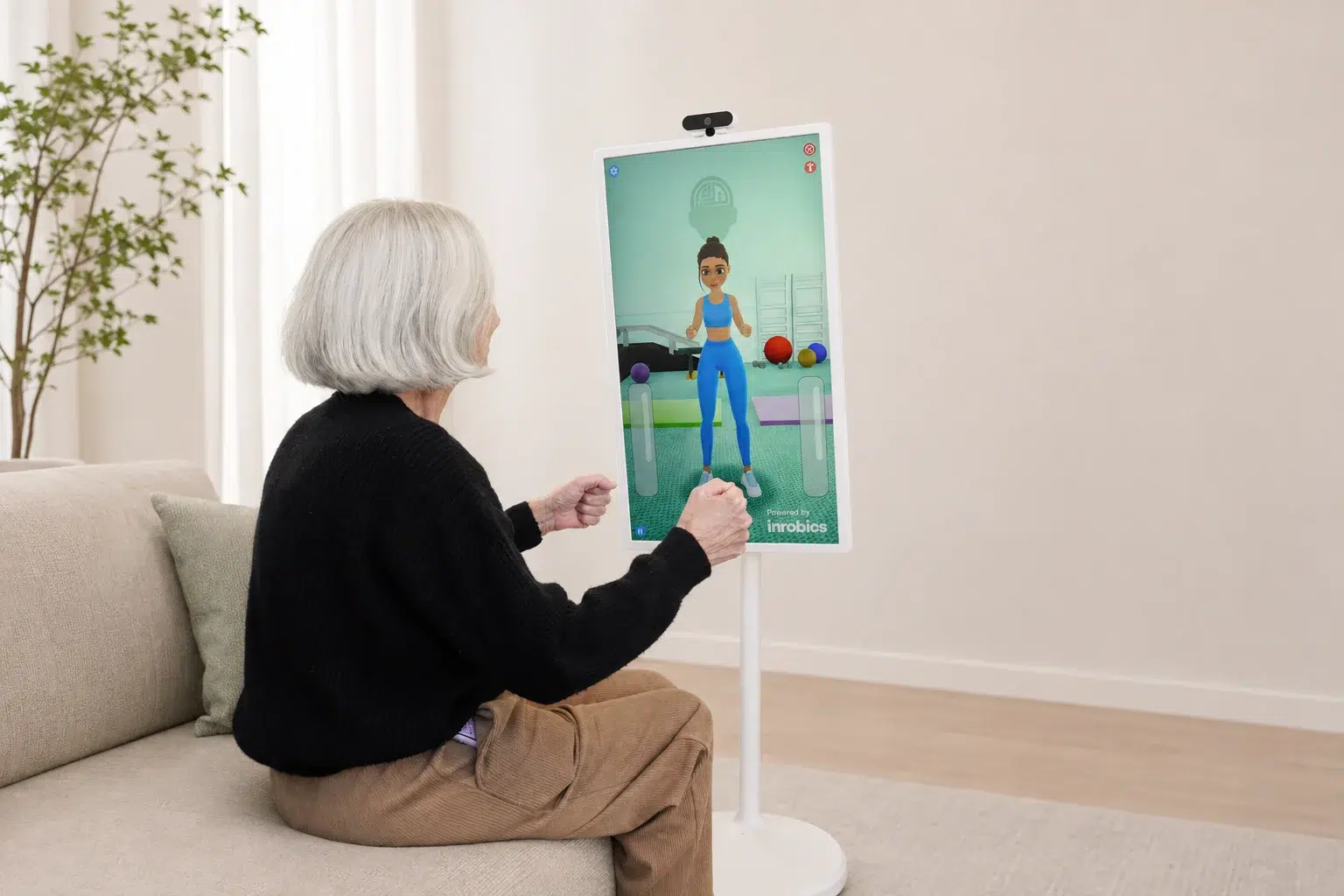
To put it simply, in this article we call physical robot to a device with a body that shares the room with the group, moves, speaks, and reacts. And we call virtual avatar a character that appears on a screen, whether it's a tablet, a television, or a computer, and that plays a similar role without a physical body.
If you want to review where all this comes from, we tell the story in the evolution of social assistance robots.
What does research say about being present?
One of the most cited reviews on this topic was published by Jamy Li in 2015, in the journal International Journal of Human-Computer StudiesHe analyzed 33 experimental studies that compared robots present in the room with robots shown in video and with virtual agents.
His conclusions, in summary:
- Robots that were physically present proved more persuasive and were perceived more positively than those that appeared on a screen.
- People performed better on tasks when the robot was in the same room than when they saw it on video.
- When both the robot and the virtual agent were displayed on screen, people did not respond differently to one or the other.
The underlying idea is useful for a center: what matters most is not that the character has a body, but that it is theresharing the space. That doesn't make an avatar a bad option. It means that if a screen is chosen, you have to be very careful about how it's integrated into the room: size, position, sound, and who's participating in the session.
Key data
Li's (2015) review compiled 33 experimental studies. His main conclusion is that physical presence in the room, rather than simply having a body, explains the differences in how people respond.
Point-by-point comparison
This table summarizes the practical differences that have the greatest impact on the day-to-day running of a day center:
| Criterion | Physical robot | Avatar on screen |
|---|---|---|
| Group attention | High: it is in the room and becomes the center of activity | It depends a lot on the screen size and its position |
| Novelty effect | Very pronounced at the beginning; continuity needs to be prepared | More discreet, it integrates into the routine more quickly. |
| Studio | You need a table or a fixed, unobstructed space. | A screen visible to the entire group is all that's needed. |
| Multiple rooms or shifts | It needs to be moved from one room to another. | It can be used on multiple screens at the same time. |
| Continuity at home | Limited | Possible, with a tablet or a computer at home |
| Equipment care | Charging, transporting and cleaning the device | The usual stuff for any screen |
| User profile | Very useful with people who are easily distracted or who respond better to tangible things. | Useful for people who already use screens or who need shorter, more frequent sessions |
Neither column wins in every aspect. That's why the useful question isn't "which is better," but "what problem do we want to solve in this center?"
When is it appropriate for each one?
The physical robot fits best if…
- The sessions are in a group, in a fixed room and with a stable schedule.
- The main challenge is to capture and maintain the group's attention.
- Some users respond better to something they can see moving nearby.
- The center wants the session to be a special moment of the day, with a clear protagonist.
The avatar on screen fits best if…
- The center has several rooms, shifts or locations and wants to repeat the same session in all of them.
- Continuity between the center and the home is sought.
- Space is limited or changes depending on the day.
- The team prefers to start with something simple to implement.
Many centers end up combining the two: the robot for the most important group sessions of the week and the avatar to provide continuity on the other days. Inrobics We work with both formats: Robic, our therapy robotand a virtual version that allows, for example, the telerehabilitation from home.
How to plan the first few weeks
Whichever format you choose, the first few weeks will determine whether the tool sticks or ends up in a closet. Here are some helpful guidelines for both cases:
- Present it calmly. A short first session, without therapeutic objectives, just for the group to get to know the character and become familiar with him.
- Start with the most receptive users. His enthusiasm wins over even the most reluctant people better than any explanation.
- Same day, same time, same room. Routine helps the session become an anticipated moment and not a passing novelty.
- A professional who is always present. To adapt the pace, help those who fall behind, and observe how each person responds.
- Review at four weeks. Based on what you've observed, decide which groups continue, which ones change, and which activities work best.
With a physical robot, it's also important to plan where it's stored, who charges it, and who moves it if it changes rooms. With an avatar, the critical factor is usually sound: a screen with small speakers in an echoey room is the quickest way to lose the group.
Six questions to ask before you choose
Before speaking with any supplier, it's advisable to answer these questions within the team:
- How many people will be in each session and in how many rooms will it be held?
- Is there a fixed location where the device can be mounted?
- Who will be in the room during the session and what role will they have?
- Do we want to continue activities at home?
- What type of users will participate: cognitive impairment, physical rehabilitation, both?
- How will we know, in three months, if it's working?
The last question is the one most often forgotten. Before you begin, decide what you're going to observe: attendance, participation in the session, attention span, or team feedback. Without that, any technology ends up being judged by the first impression.
And an idea we often repeat: technology only makes sense within a well-thought-out intervention, with professionals behind it. We explain this in more detail in Social robotics and artificial intelligence in healthcare: a new way of supporting.
FAQ
It depends on the use. A robot present in the room tends to attract more attention in group sessions. An avatar on screen is easier to use in multiple rooms at once and to take home.
Generally, yes, especially if the screen is large, the sound is clear, and there's a professional guiding the session. The presentation and the first few sessions are key to making them feel comfortable.
Yes. It's common to reserve the robot for the main group sessions and use the avatar to continue the activity in other rooms or at home.
Usually, a table or a fixed and unobstructed place, visible to the whole group, with a nearby power outlet and good acoustics, is sufficient.
No. They follow the script and the pace of the activity, but the planning, adaptation to each person, and the evaluation remain the work of professionals.
to close
Robot or avatar isn't a choice between modern and old-fashioned, or between expensive and cheap. It's a decision about how the sessions are organized at your center: how many rooms, how many people, how much space, and who will facilitate them. With those answers in mind, the choice usually makes itself.
Are you undecided between the two formats for your center? Let's talk for 15 minutes, without obligation, and we'll look at it with your numbers.
Fonts
- Li J. The benefit of being physically present: A survey of experimental works comparing copresent robots, telepresent robots and virtual agents. International Journal of Human-Computer Studies, 77, 23-37. 2015.
