

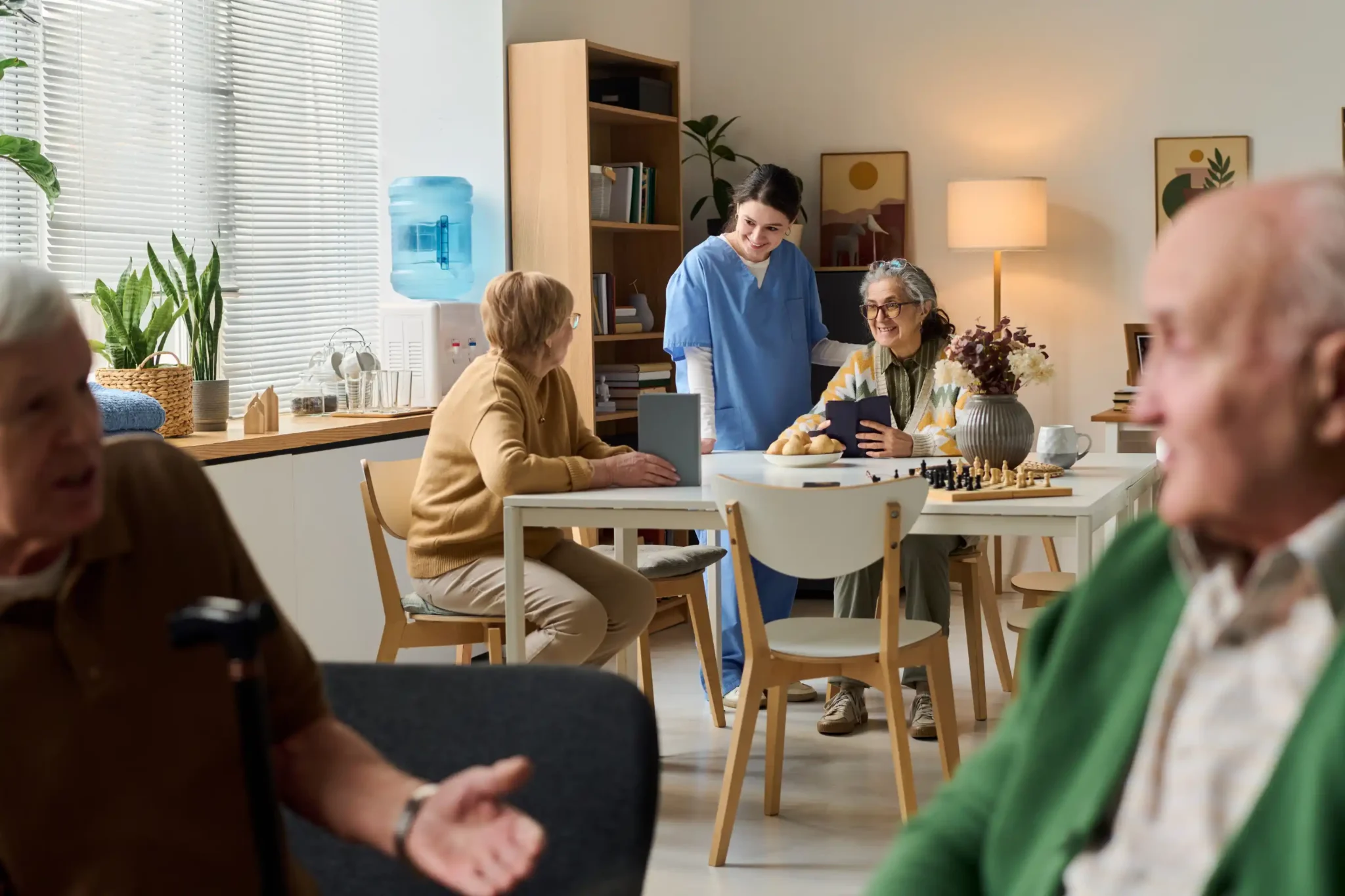
Three paths to a job, with very different costs, timelines, and freedom of choice. What each one offers and how to decide.
A public or subsidized place is obtained through the dependency system and the family pays according to their economic capacity; a private place is chosen and contracted directly, and the full price is paid, although it can be supported by the benefit linked to the service. Public schools save money; private schools offer speed and freedom of choice; subsidized schools combine private centers and public conditions.
Below you have the details of each option, a comparison table, how many places there are in Spain and a list of questions to ask when visiting any residence.
Spain had 5.573 care homes and 393.581 places in 2022, according to the CSIC (Spanish National Research Council), most of them in private centers. To access a place in a public or subsidized care home, a person needs to have a certain level of dependency and their individual care plan must include it. The benefit linked to the service helps pay for a private place when there is no public place available. Quality depends on the center, not the label.
The three options, piece by piece.
1. Public square
| Ownership | Center of an administration, with direct management or management entrusted to an entity |
|---|---|
| Access | Through the dependency system: recognized degree and individual care plan |
| Cost to the family | Co-payment according to the person's economic capacity |
| Choice of center | Limited; assigned based on availability and preferences |
For whom: People with a recognized degree of dependency whose family cannot afford the price of a private place and who can wait until a place becomes available.
2. Subsidized place
| Ownership | Private center that reserves places for the administration through an agreement or contract |
|---|---|
| Access | The same as the public square |
| Cost to the family | Co-payment based on economic capacity, as in the public sector. |
| Coexistence | The center is shared with residents of private squares. |
For whom: In practice, the family experiences it much like a public square. It's worth asking if the included services are the same for all residents.
3. Private square
| Access | Direct, contracting with the center, with or without a degree of dependency. |
|---|---|
| Cost to the family | Full price; may be reduced with the service-linked benefit if the center is accredited |
| Deadlines | There is usually a parking space available sooner than on the public road. |
| Choice of center | Free |
For whom: Families who need a place soon, who want to choose a specific center, either because of its proximity or its project, and who can afford the cost.
Comparison chart
| Appearance | Public or subsidized | Private |
|---|---|---|
| Prerequisite | Degree of dependency and individual care plan | None, except those from the center itself. |
| Ribs | Co-payment based on income and assets | Market price, with possible linked benefit |
| Speed | It depends on the waiting list of each community | Usually faster |
| Choosing the center | Limited | Free |
The calculation of co-payments, public prices and requirements are set by each autonomous community.
How many places are there?
Are there enough places? According to the CSIC's Networked Aging Laboratory, in September 2022 there were 5.573 nursing homes in Spain with 393.581 places, approximately 4,2 per 100 elderly people, with an estimated occupancy rate of around 86%. Private centers more than doubled the number of public ones.
Note the interpretation: the fact that there are more linked benefits than public or subsidized residential places partly reflects that many families end up in a private center because there are no public places available. We compare the two options in detail in another article in this series.
How to decide
- Request a dependency assessment as soon as possible. Even if you choose a private university place, the degree opens the door to linked benefits. We explain it in detail in How to request a dependency assessment.
- Calculate the actual cost. Ask social services what the co-payment would be in a public place and compare it with the private price minus the linked service.
- Assess the urgency. If the situation at home is unsustainable, the private route can be a bridge until the public square arrives.
- Visit several centers. Public or private labels say little about quality. Use our guide to What to ask when visiting a residence.
- Think about closeness. A center close to the family facilitates frequent visits, and that has a significant impact on well-being.
A warning about the 2026 reform. Law 4/2026, which came into force on October 23, 2026, reduces the processing time for dependency claims to three months and eliminates incompatibilities between benefits, without prejudice to the regulations of each autonomous community. Ask how it applies in yours.
If you're still undecided between a care home and a day center, we can help. residence or day centerIn any residence, public or private, daily life depends heavily on activities; in Inrobics We work with social robots that help teams provide more stimulation and group exercise.
Checklist before choosing
FAQ
The public school is located in a government-run center; the private school, which is subsidized, is in a private center that reserves places for government students. For families, access and co-payments are the same.
Requesting a dependency assessment and that the individual care plan include residential care services. Placement is subject to availability.
A co-payment that depends on the person's economic capacity, according to the rules of each autonomous community.
Yes. With a recognized degree of dependency, the financial benefit linked to the service helps to pay for a place in an accredited private center.
Not necessarily. Quality varies from center to center. It's a good idea to visit several and ask about the service, the staff, and the daily activities.
Fonts
- Valencia Plaza, with data from the Networked Aging Laboratory (CSIC). Spain has more than 5.500 nursing homes and 3.400 day centers, October 31, 2023.
- IMMERSE Statistical information on the SAAD. Situation as of March 31, 2026.
- BOE. Law 4/2026, of October 1, which modifies Law 39/2006.
None of the links in this comparison are sponsored. Inrobics It develops social robots for residences and day centers; it does not manage places or benefits.
What families ask during the visit
If you want to strengthen the activity program of your residence, public, subsidized or private, we'll tell you how we do it with social robotics.
Let's talk for 15 minutesWithout obligation
Read
"Public or private etiquette says little; the visit says almost everything."
