

Reading time: 8 minutes
Fast answer: When visiting a care home or day center, in addition to inquiring about the facilities and price, ask about the daily activities, especially in the afternoon, who leads them, how they are tailored to each individual, and what happens when staff are needed. Also, observe whether the rooms are lively or just filled with a television.
In 30 seconds
- The activities say a lot about the quality of the day-to-day experience, and they almost never appear in detail in the brochure.
- The afternoon slot is what most differentiates one center from another.
- Ask who leads the activities and how they are tailored to your family member, not just what activities are available.
- What you observe during the visit is worth as much as what they tell you.
In this article
- Why focus on the activities
- Before the visit
- Twelve questions about the activities
- What is worth observing without asking
- How to compare several centers
- After the visit
- FAQ
Why focus on the activities
When a family is looking for a care home or day center, they usually focus on what's immediately apparent: the bedrooms, the dining room, the location, and, of course, the price. These are important things. But what will have the greatest impact on how your loved one lives each day is something else entirely: what they do between breakfast and dinner.
Activities make the difference between just getting through the day and truly living it. They maintain mobility, stimulate memory, provide opportunities to socialize, and help preserve independence in daily tasks, something we explain in our article on instrumental activities of daily living.
Key data
According to the CSIC's Networked Aging Laboratory, in 2022 there were 5.573 nursing homes in Spain, with 393.581 places, and some 3.460 day centers, with nearly 95.000 places. There are many options, and that's why it's worth comparing them carefully.
There's also a practical reason: almost every center's brochure says the same thing ("leisure activities," "occupational therapy," "workshops"). The difference lies in the details: how many times a week, in which groups, with which professionals, and at what time. These details only come up when you ask for them specifically, so it's worth coming prepared with your questions.
Before the visit
- Request a visit during business hours. Not first thing in the morning or at lunchtime. If you can, go in the afternoon.
- Write down what your family member needs: mobility, memory, character, hobbies, things he dislikes.
- If possible, go with him or her. Their reaction to the place is also information.
- Request the program of activities in writing so that we can compare it later.
Twelve questions about the activities
These questions help you move beyond simply saying "we have a lot of activities." The table also shows what kind of response is reassuring and what might be a red flag.
| Interrogatory | A reassuring answer | alert signal |
|---|---|---|
| What activities take place on a normal day, hour by hour? | They explain it to you in detail and show you the schedule. | Vague answers: "a little bit of everything" |
| And afternoon? | There are also activities scheduled for the afternoon | The afternoon is simply "free time". |
| Who leads the activities? | Occupational therapist, physiotherapist, psychologist or sociocultural animation | "The assistants when they have a moment" |
| Is there cognitive stimulation? How many times per week? | Fixed sessions, in small groups, several times a week | Only worksheets to complete solo |
| How are the activities adapted to each person? | There is an initial assessment and groups based on abilities. | Everyone does the same thing |
| Is there group physical activity or physiotherapy? | Yes, with a schedule and professional. | Only if paid separately, no further explanation. |
| What if my family member doesn't want to participate? | He is encouraged with other suggestions according to his tastes | "He stays in the room" |
| What activities are maintained when there is a staff shortage? | They have a plan B and sessions that can be conducted by someone else. | They are suspended without alternative |
| Are there any outings or activities with the neighborhood? | Walks, visits, activities with schools or associations | You never leave the center |
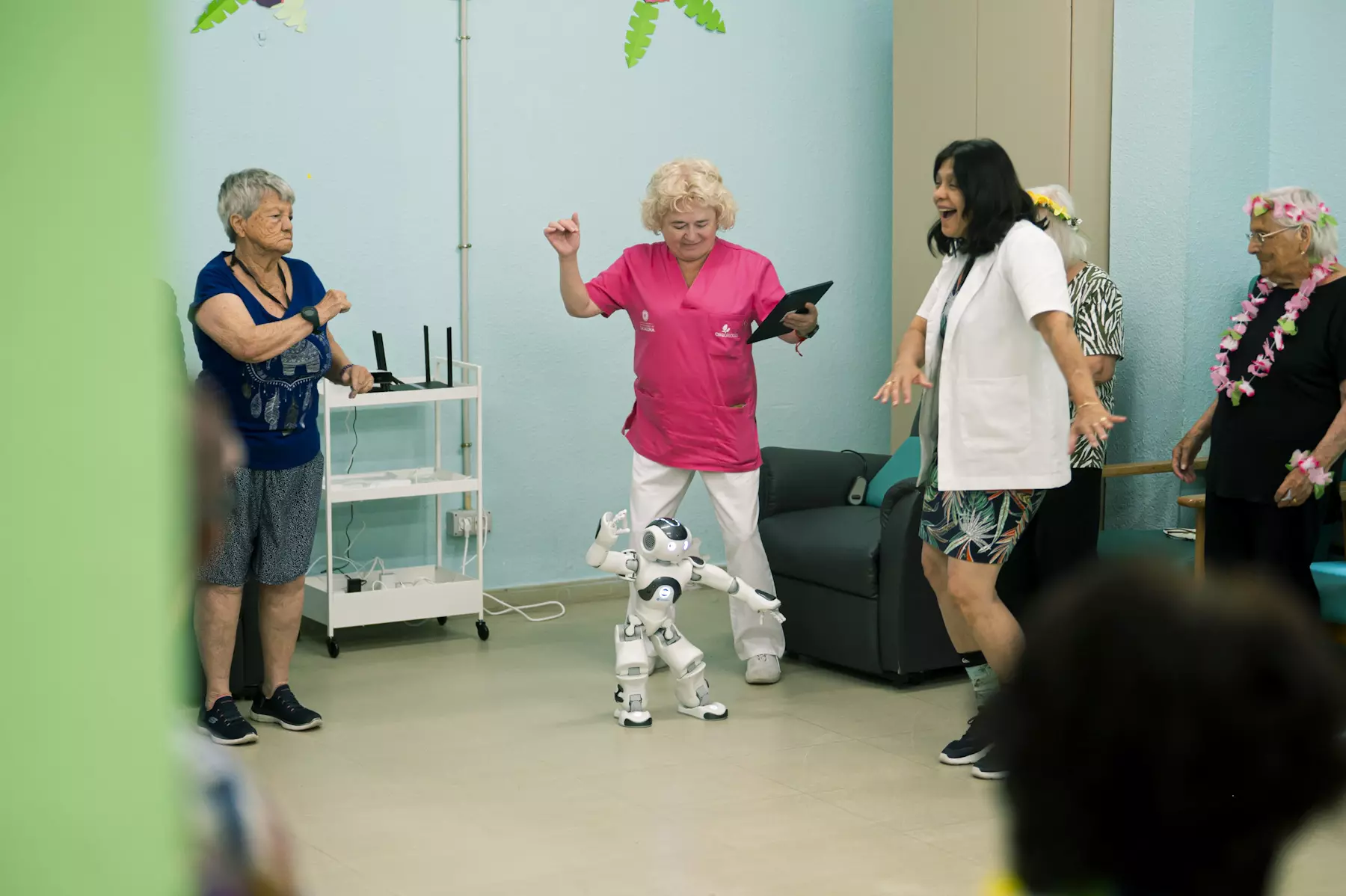
| Do they use any technology in the activities? | They explain what it is, why it's for, and who accompanies it. | A screen turned on as the only activity |
| How do you inform me about your participation? | Regular meetings or simple reports | "If anything happens, we'll call you." |
| Can the family participate in any activities? | Yes, there are times open to families. | Visits are only allowed in the room or at reception. |
If your family member has cognitive impairment, it's worth emphasizing cognitive stimulation. We'll tell you what it involves. How to enhance cognitive stimulation in older adultsAnd if you have dementia, you might also be interested in this. How robotics is being used in the care of people with dementia.
What is worth observing without asking
During the visit, your eyes are just as useful as your questions. Look for these signs:
- The activity board: Is it up-to-date, with this week's date, or is it from months ago?
- The common rooms: if there are people doing something or sitting in a row in front of the television.
- The deal: if staff call residents by name and crouch down to speak to them at their eye level.
- The work done in workshops: if they are exposed and if they are activities for adults, not for children.
- The sound environment: Conversation and music are more calming than total silence or constant noise.
- How they respond to you: whether they let you watch an activity in progress or if they prefer not to.
How to compare several centers
After two or three visits, the memories become mixed up. A simple table, filled out upon leaving each center, helps to decide calmly:
| Appearance | Center A | Center B | Center C |
|---|---|---|---|
| Afternoon activities | |||
| Professionals who manage them | |||
| Cognitive stimulation (times per week) | |||
| Adaptation to each person | |||
| Atmosphere in the rooms | |||
| Information to families | |||
| My family member's reaction |
You can rate each box from 1 to 3. It's not about adding up the scores and choosing the highest number, but about seeing at a glance where each center excels and what is most important to your family.
After the visit
The decision is rarely made in the moment. These steps help in the following days:
- Talk to your family member about what he has seen and how he has felt, even if his answer is brief.
- She asks to speak with other families. From the center, if possible. Their day-to-day experience is hard to find elsewhere.
- Ask if there is an adjustment period or the option of starting a few days a week, especially in day centers.
- Come back without an appointment, If the center allows it, at a different time. What you see on an unannounced visit is usually the closest thing to reality.
- Review in writing What the price includes: what activities, therapies, and services are charged separately.
And once inside, communication with the team remains the best tool. Asking periodically how your family member is participating in the activities, and what they enjoy most, helps the center get to know them better and detect any problems early on.
FAQ
In addition to the price and facilities, ask what activities are available each day and in the afternoon, who leads them, how they are adapted to each person, what happens when there is a staff shortage, and how the family is informed.
During activity hours, preferably in the afternoon. That's when you can best see if the center keeps people engaged or if time just passes without any activities.
Typically, occupational therapists, physiotherapists, psychologists, and community outreach professionals participate, each in their respective field. Ask who is in charge of each activity.
The programs with the best results in the studies are conducted at least twice a week, in small groups. This is a good benchmark for comparing centers.
It can be, if they explain what it's used for and there's a professional present. A screen turned on without anyone leading the activity is not the same as a guided session.
to close
Choosing a care home or day center is a difficult decision, and it's almost always made in haste. Having these questions prepared doesn't guarantee you'll make the right choice, but it does help you focus on what really matters: how your loved one will spend their days. If the afternoon is full of life, that's a very good sign.
Do you work in a center and want to have more activity in the afternoons without overloading the team? Let's talk for 15 minutes, without obligation.
Fonts
- Networked Aging Laboratory (CSIC). Count of residences and day centers for older people, 2022 data. Collected by the Disability Information Service (University of Salamanca).
- Woods B, et al. Cognitive stimulation to improve cognitive functioning in people with dementia. Cochrane Database of Systematic Reviews, 2023.
