

Reading time: 8 minutes
Fast answer: Children often abandon their exercises at home, especially when there are too many, complicated, boring, or difficult exercises to fit into the family routine, and when parents are exhausted or don't understand their purpose. It helps to reduce the program to a few exercises, turn them into games, explain their objective, and maintain a close relationship with the therapist.
In 30 seconds
- Home exercise programs are an important part of childhood rehabilitation, but many families are unable to maintain them.
- The reasons have to do with the child, the family, and how the program is designed and implemented.
- The factor that the studies highlight most is a relationship of trust and collaboration with the therapist.
- Fewer exercises, better explained and more fun, usually work better than a complete program that nobody follows.
In this article
- The problem: what happens between sessions
- What do studies say about adherence?
- Why people quit: factors and what to do about each one
- Seven strategies that help maintain your exercise routine
- The role of play and technology
- FAQ
The problem: what happens between sessions
A child with cerebral palsy or another neurological injury may have one or two physiotherapy or occupational therapy sessions per week. The rest of the time they are at home, at school, or in the park. That's why almost all pediatric rehabilitation teams provide families with an exercise program to do at home.
On paper, it makes perfect sense: more practical, in the child's real environment, with the people who know them best. In practice, many families abandon it within a few weeks. Not for lack of affection or interest, but because daily life leaves no room: work, siblings, homework, exhaustion, and a child who, quite rightly, prefers to play.
If you want to review the basics of this condition, we have a guide on Cerebral palsy in children, its impact and rehabilitation.
What do studies say about adherence?
In 2024, an international team published in the journal PLoS ONE A systematic review of 13 studies on what makes parents of children with cerebral palsy maintain, or not maintain, home exercise programs.
Key data
In the reviewed studies, between 34% and 79,2% of families did not follow the home exercise program as instructed (Niyonsenga et al., 2024). These figures were self-reported by the families, so the actual number could be different.
More interesting than the exact figure is what the review uncovered behind it. The authors group the factors into three categories:
- The child: Their level of motor function and their age have an influence, although the results are not entirely consistent between studies.
- The family: Parents' confidence in their own abilities, their knowledge of the exercises, and the support they receive help maintain them. Stress, anxiety, emotional exhaustion, and family problems have the opposite effect.
- The therapist and the program: A close and collaborative relationship with the professional is the most important factor. Other important factors include the number of exercises, the family's understanding that they are effective, that they don't hurt, and that they are easy and enjoyable.
The authors caution that most of the studies were cross-sectional and had small sample sizes, so they don't allow for conclusions of cause and effect. Even so, the message is clear and aligns with the experience of many teams: adherence doesn't depend solely on the family; it also depends on how the program is designed and implemented.
Why people quit: factors and what to do about each one
| What slows it down | Why does it weigh | What can be done |
|---|---|---|
| Too many exercises | The family doesn't know where to start and ends up doing nothing. | Choose two or three priority projects and expand only when they are consolidated. |
| Complicated exercises | Parents are afraid of doing wrong or causing harm. | Practice them together in consultation and provide a video or a worksheet with drawings. |
| It's not clear what they're for. | Without a clear objective, it's difficult to prioritize them over other tasks. | Link each exercise to something concrete: getting on the bus, eating alone, getting dressed |
| The child is bored | Repeating the same movement holds no appeal for a child | Turn it into a game, a challenge, or part of an activity they enjoy. |
| Parental fatigue | Stress and exhaustion reduce consistency | Divide the program among several adults and ask about how the family is doing, not just about the exercises. |
| Feeling of guilt | A follow-up that feels like an exam can cause the family to distance themselves. | Review without judgment: what has worked, what hasn't, and what we changed |
Seven strategies that help maintain your exercise routine
- Agree on the program with the family. Ask what days and times it is realistic to exercise before deciding how many.
- Few and well chosen. Two or three exercises done regularly are worth more than ten on paper.
- Get them hooked on the routine. After the bath, before dinner, during drawing: a fixed time that doesn't depend on remembering.
- Explain why. When parents know the objective of each exercise, they prioritize it more easily.
- Make it fun. Stories, songs, challenges with prizes, target games. Play is the child's natural language.
- Register easily. A calendar on the refrigerator with stickers is useful for the family and for the therapist.
- Check every few weeks. Fix what isn't working before the family abandons it completely.
Behind all of them lies the same idea: the program must adapt to the family, not the other way around. Repeated practice in the child's environment makes sense because the developing brain learns through repetition, something we explain in our article on neuroplasticity and how to enhance it.
The role of play and technology
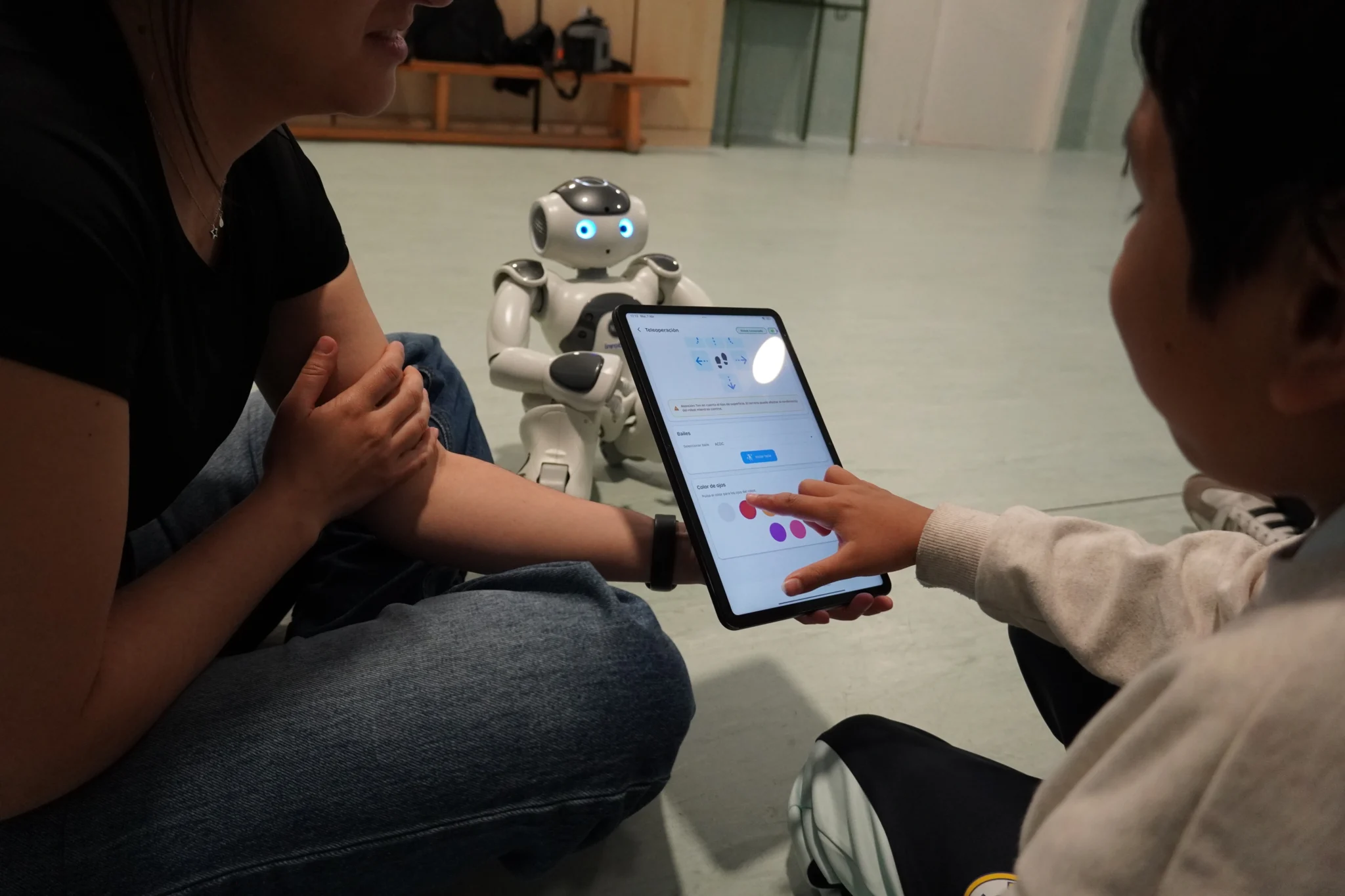
One of the factors most frequently highlighted in studies is that the exercises should be enjoyable. This is where games, therapeutic video games, and social robotics can make a difference: they transform a boring repetition into a challenging activity with immediate feedback and a character that encourages continued participation.
That doesn't make them a magic solution. A tool only helps if it's well integrated into the therapist's plan, if it's adapted to the child's level, and if the family can use it without difficulty. We explain this in more detail in Social robots and video games in the rehabilitation of childhood cerebral palsy.
En Inrobics We design the sessions so that the child experiences them as a game, both in the consultation room and at home with our telerehabilitation solutionalways with the therapist setting the plan.
Checklist for the therapist before delivering a home program
- Have we agreed with the family on when and how long is realistic?
- Are there three exercises or fewer to start with?
- Have our parents practiced them in front of us?
- Do you know what each one is for?
- Is there at least one exercise that the child experiences as a game?
- Do they have an easy way to record what they do?
- Have we set a date for reviewing the program?
FAQ
There's no single number, but starting with two or three priority exercises is usually more realistic than a long program. It can be expanded once the family is doing them regularly.
It's very common. Repeating movements isn't appealing to a child. Turning them into a game, challenging them, or integrating them into something they enjoy often makes a big difference. Discuss this with their therapist to adapt the exercises.
One day off isn't a problem. What's important is consistency over the weeks. If you miss several days in a row, it's a sign to review the program with your therapist, not a reason to feel guilty.
Ask your therapist to practice it with you at the next session and, if possible, ask for a video or a worksheet with pictures. It's better to ask than to avoid it for fear of making a mistake.
No. They can make the exercises more appealing and help children maintain them, but they must be part of the plan set by the therapist and adapted to each child's level.
to close
When a family stops doing the exercises, it's easy to assume the family has failed. However, studies point to something more helpful: often the problem lies in a program that is too long, unclear, or unappealing to the child. And that's something that can be changed during a consultation.
Do you work in pediatric rehabilitation and want to see how we turn exercises into games? Let's talk for 15 minutes, without obligation.
Fonts
- Niyonsenga J, Uwingeneye L, Musabyemariya I, Sagahutu JB, Cavallini F, Caricati L, et al. The psychosocial determinants of adherence to home-based rehabilitation strategies in parents of children with cerebral palsy: A systematic review. PLoS ONE, 19(6), e0305432. 2024.
