

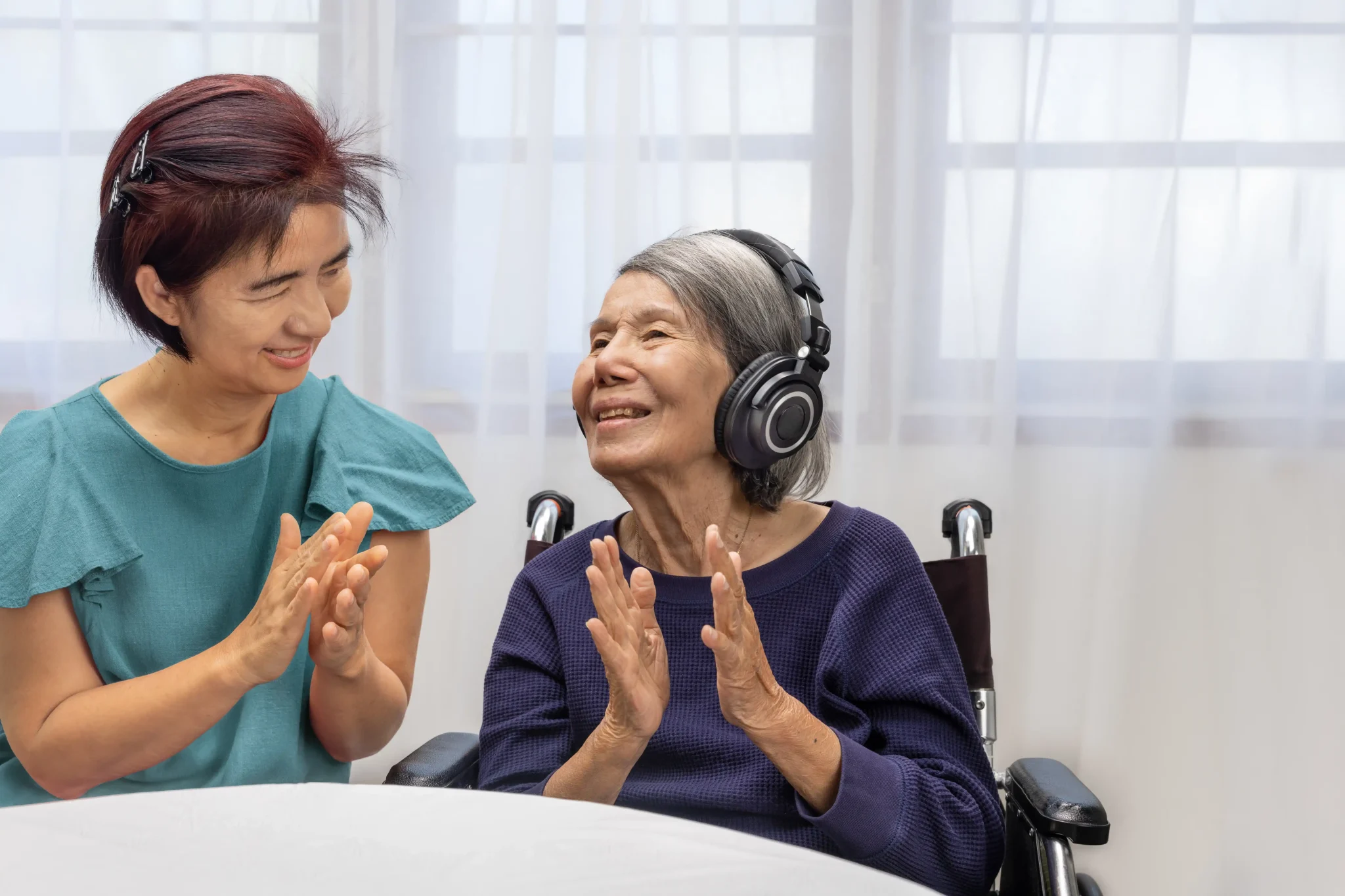
Singing together and doing music therapy are not the same thing. Both have their place, but they aim for different things.
Music therapy is led by a trained professional, with therapeutic goals and follow-up; musical activities, such as singing or listening to favorite music, can be organized by the team, family, or volunteers. According to the 2025 Cochrane review, therapeutic interventions with music probably improve depressive symptoms in dementia to some extent by the end of treatment. There is no evidence that they improve agitation or memory, and their long-term effects are uncertain.
Below you have the two options in sheet form, the evidence result by result and how to combine them at home or in a center.
The 2025 Cochrane review compiled 30 trials with 1.720 people with dementia, mostly in care homes, and required at least five sessions. It showed probable improvement in depression, possible improvement in behavioral problems, and no clear benefit in agitation, anxiety, or cognition. Music therapy serves specific purposes; musical activities are for enjoyment and daily interaction.
The two options, piece by piece.
1. Music therapy
| Who runs it | A music therapist with specific training |
|---|---|
| How is it | Initial assessment, objectives, planned sessions and progress tracking; individual or in a group |
| What includes | Active elements, such as playing instruments or singing, and receptive elements, such as listening to live music |
| So that | Specific objectives: mood, behavior, communication |
2. Musical activities
| Who organizes them | The center's team, the family, or the volunteers |
|---|---|
| What are they like? | Choirs, dances, sessions of well-known songs, personal music playlists |
| Frequency | They can be part of everyday life |
| So that | Enjoyment, memories, relationships with others, and participation |
What the evidence says, result by result
The Cochrane review by van der Steen et al., published on March 7, 2025, analyzes music-based therapeutic interventions, including but not limited to music therapy, with a minimum of five sessions. It compares their outcomes with usual care at the end of treatment.
| Result | Compared to usual care | Certainty |
|---|---|---|
| Depressive symptoms | They probably improve somewhat | Moderate |
| Behavioral problems in general | Can improve | Low |
| Agitation and aggression | They probably won't get better. | Moderate |
| Anxiety, emotional well-being, and cognition | No clear improvement | Low to very low |
Compared to other activities, the review found that music intervention could improve social behavior, with low certainty. No serious adverse effects were reported, although the trials reported them inconsistently.
Pay attention to the reading: The benefits were measured at the end of treatment. Four weeks or more later, the advantage over usual care is uncertain. Furthermore, most participants lived in residential care facilities, and the review did not separately assess recreational musical activities.
Comparison chart
| Appearance | Music Therapy | musical activities |
|---|---|---|
| Objective | Therapeutic and personalized | Enjoyment and participation |
| Necessary training | Specialized in music therapy | None in particular, although it helps to know the person |
| Account management | Record of objectives and progress | Informal observation |
| Ribs | Professional fees | Low |
A warning about the profession. In Spain, music therapy is not yet officially regulated as a healthcare profession. When hiring a therapist, ask about their specific training, such as a university master's degree in music therapy, and about their experience working with people with dementia.
How to combine them at home or in a center
- Use music therapy for specific goals. For example, when there is persistent sadness or behavioral problems, and always coordinated with the healthcare team.
- Create a personal music playlist. Songs from one's youth and those linked to important moments tend to elicit a stronger response. Ask your family.
- Observe how he reacts. If a song makes you feel uneasy or sad, change it. Music doesn't always soothe.
- Avoid continuous background music. Constant noise can be tiring and make conversation difficult.
- Check your hearing. Untreated hearing loss limits any activity involving sound. We explain this in Hearing loss and loneliness in older people.
For agitation, music alone is usually not enough; you have other guidelines in difficult behaviors in dementia. In Inrobics We work with social robots that guide group physical and cognitive activity sessions, as a complement to the work of the professional team.
Checklist before starting
FAQ
Music therapy is led by a trained professional, with assessments, therapeutic goals, and follow-up. Musical activities, such as singing or listening to music, aim for enjoyment and participation and can be organized by the team, family, or volunteers.
According to the 2025 Cochrane review, therapeutic interventions with music probably improve depressive symptoms somewhat by the end of treatment and may improve behavioral problems. They have not been shown to improve agitation or cognition.
The Cochrane review found no clear improvement in cognition. Music may evoke memories and emotions in the moment, but that doesn't equate to halting the decline.
The Cochrane review included interventions of at least five sessions. The appropriate number should be determined by the practitioner based on the objectives.
It is not yet officially regulated as a healthcare profession. It is advisable to ask about the professional's specific training and experience with dementia.
Fonts
- Cochrane. Music-based therapeutic interventions for people with dementia (van der Steen JT et al., CD003477), March 7, 2025.
- Cochrane Iberoamerica. Music therapy may improve depressive symptoms in people with dementia, March 2025.
- HealthDay. Music-based interventions may help short-term depression, behavior with dementia, March 11, 2025.
- Pablo de Olavide University. Master's Degree in Continuing Education in Applied Music Therapy.
None of the links in this comparison are sponsored. This content is for informational purposes only and does not replace the advice of a healthcare professional.
More activity sessions, same team
If you want to expand group activities for people with dementia without overloading your team, we'll tell you how we work.
Let's talk for 15 minutesWithout obligation
Read
"A well-known song can open a conversation that seemed closed."
